Muslim-Friendly Japanese Confectionery: 2026 Supermarket Guide
Quick Answer: None of the popular Japanese supermarket snacks in this guide are halal-certified. Of the five widely available products checked here, only one, Echigo Seika's Funwari Meijin Kinako Mochi, has an official ingredient list that names only plant oils and lists no pork, gelatin or alcohol; we rate it ⚠ Muslim-friendly with cross-contamination risk, not ✅ Confirmed halal. Fujiya's Home Pie, Bourbon's Alfort and Elise and Kameda Seika's Happy Turn list fats or other ingredients whose plant or animal origin the makers do not disclose, so we rate them ❓ Unconfirmed. Always re-check the on-pack label, since manufacturers update recipes.
✅ Written and halal-verified by Zeshan Hayat
CMO & Head Halal Auditor, Halal Navi
Published May 16, 2026 · Last verified October 2, 2026
Each product's ingredient list was checked against the manufacturer's current official product page (Bourbon, Fujiya, Echigo Seika, Kameda Seika). We found no halal certification for any of these snacks: none of the four makers appears on NPO Japan Halal Association's (JHA) public list of certified companies, and Kameda Seika states that its products are not halal-certified. None of them is described as "halal" in this guide.
How we verified the Muslim-friendly status of every snack in this guide
Halal status for packaged snacks in Japan is rarely black-and-white. Manufacturers reformulate, regional flavors differ, and the same brand can be halal-certified abroad but not in Japan. Here is exactly how we approached this list.
For each product we checked four things:
- The current ingredient list on the manufacturer's own Japanese product page, re-checked on 2 October 2026.
- Whether the emulsifier (乳化剤) and shortening (ショートニング) are plant-derived, as these are the two most common hidden animal-fat risks in Japanese snacks.
- Whether any flavoring (香料) is alcohol-based, since Japanese labels do not say whether a flavoring was made with alcohol.
- The certification database of NPO Japan Halal Association, which is approved by JAKIM (Malaysia), MUIS (Singapore), BPJPH (Indonesia), HAK (Turkey), GAC (Gulf countries) and MOIAT (UAE): to confirm that none of these products appear as currently halal-certified.
We did not include any snack whose manufacturer page disclosed pork-derived emulsifiers, animal-derived gelatin, mirin, or cooking sake. We also did not include snacks reliant on seasonal cream fillings or chocolate coatings where the emulsifier source is unclear on the public label.
Why most Japanese konbini snacks are not halal-certified, even when the ingredients look clean
Many Japanese snacks are made in factories that also produce other products, and halal certification involves audits of ingredients and production, a significant commitment for a large snack maker.
According to NPO Japan Halal Association's certification framework, only around 70 companies in Japan currently hold halal certification for products and raw materials, and most are bulk ingredient or food-additive suppliers, not consumer-snack brands. Major snack manufacturers like Bourbon, Fujiya, Echigo Seika, and Kameda Seika do not appear on JHA's public list of certified companies (checked 2 October 2026).
That is why this guide uses the term Muslim-friendly, not halal. Concretely:
- ✅ Confirmed halal: a recognized body issued a certificate. None of the snacks below.
- ⚠ Muslim-friendly: no haram ingredients on the current label, but cross-contamination on shared lines is possible, some additives (such as emulsifiers and flavorings) do not have every component's origin disclosed, and recipes can change without notice. One of the five snacks below.
- ❌ Not halal: contains pork, alcohol, or animal-derived emulsifier on the label.
- ❓ Unconfirmed: label is ambiguous; ask the manufacturer. Four of the five snacks below.
With that frame in mind, here are the five snacks worth knowing about.
1. Alfort (Bourbon): chocolate-covered digestive biscuit
Status: ❓ Unconfirmed · Not halal-certified
Last verified: October 2, 2026
Source: Bourbon Alfort official product page
Alfort is a small chocolate biscuit shaped like a sailing ship. According to Bourbon's official Alfort brand site, the product combines a whole-wheat digestive biscuit with milk chocolate, and the lineup includes a Rich Milk variant plus regional editions such as Uji Matcha (Kansai), Gorojima Kintoki sweet potato (Hokuriku), Tochi-aika strawberry (Tochigi), and Beni-imo purple sweet potato (Okinawa).
The ingredients on Bourbon's current label (standard Alfort): wheat flour (made in Japan), sugar, whole milk powder, cacao mass, shortening, vegetable oil and fat, whole wheat flour, cocoa butter, wheat bran, salt, defatted wheat germ, leavening agent, emulsifier (soy-derived), flavor, antioxidant (vitamin E).
The label marks the emulsifier as soy-derived (a Japanese allergen notation), but it does not say whether the shortening is plant- or animal-based, and Bourbon's own FAQ explains that shortening can be made from plant or animal fats. No pork, gelatin or alcohol is listed on the current label, but until Bourbon confirms the shortening source we rate Alfort ❓ Unconfirmed.
Caveats:
- The "flavor" (香料) ingredient is not broken down further; if you want zero alcohol-trace risk, stick to the standard Alfort rather than flavored or regional editions, whose ingredient lists we did not check.
- The product page marks the emulsifier as soy-derived; regional flavors may differ. Re-check the on-pack label.
2. Elise (Bourbon): chocolate-and-white-cream wafer rolls
Status: ❓ Unconfirmed · Not halal-certified
Last verified: October 2, 2026
Source: Bourbon Elise official product page
Elise is a crispy wafer roll filled with chocolate cream and white cream, packaged so each bag contains both flavors. Bourbon's product detail page describes it as "a wafer with rich chocolate cream and mild white cream" with a JAN code of 4901360360758 for the 32-stick pack.
The Elise lineup also includes Hokkaido Milk, W (Double) White, Setouchi Lemon (regional), Kumejima Beni-imo (Okinawa regional), and Wa-guri (Japanese chestnut, seasonal): flavors confirmed from Bourbon's Elise search results page.
What to watch for:
- The standard chocolate-and-white Elise contains dried egg yolk and dairy components; no pork, gelatin or alcohol is listed on the label.
- It also contains processed edible fat (食用加工油脂) whose plant or animal origin is not stated, so we rate it ❓ Unconfirmed.
- The emulsifier is marked soy-derived, which is a Japanese allergen notation rather than a full statement of origin.
- Avoid the fruit-flavored regional Elises (Setouchi Lemon, Kumejima Beni-imo) , we did not check their ingredient lists, and the label does not say whether the flavoring was made with alcohol.
Neither Bourbon product can be confirmed free of animal fat from its public label. If this matters to you, ask Bourbon's customer centre before buying.
3. Home Pie (Fujiya): buttery layered pie biscuit
Status: ❓ Unconfirmed · Not halal-certified
Last verified: October 15, 2026
Source: Fujiya 38-piece Home Pie product page
Home Pie has been a Fujiya staple for decades. Fujiya's official Home Pie brand site describes the product as a butter-forward pie built from approximately 700 layers of dough, using Fujiya's in-house levain (ルヴァン種) and butter folded into the dough.
The ingredients on Fujiya's current 38-piece Home Pie page: wheat flour, vegetable oil and fat, sugar, butter, levain culture (contains wheat), whole milk powder, salt, skimmed milk powder, protein-concentrated whey powder (contains dairy), food primarily made from milk components, syrup, emulsifier (wheat- and soy-derived), flavor (dairy-derived), carotenoid coloring. Fujiya also notes: "This product is manufactured in facilities that also handle eggs."
No pork, gelatin, shortening or alcohol is listed, and the oil is listed as vegetable oil (植物油脂). The emulsifier is marked wheat- and soy-derived, a Japanese allergen notation rather than a full statement of origin. Butter and milk components are present. The list also includes a "food primarily made from milk components" (乳等を主要原料とする食品) whose full contents Fujiya does not disclose, and Fujiya does not state how the whey powder or the flavoring were produced. That is why we rate Home Pie ❓ Unconfirmed, the same standard we apply to Alfort, Elise and Happy Turn. Strict consumers may wish to ask Fujiya.
Caveats:
- Cross-contamination with egg-containing product lines is officially declared by the manufacturer. This is not a halal issue (egg is permissible), but worth knowing if you have an allergy.
- Flavored Home Pie variants have different ingredient lists, which we did not check.
4. Funwari Meijin Kinako Mochi (Echigo Seika): soybean-flour rice puff
Status: ⚠ Muslim-friendly · Not halal-certified
Last verified: October 2, 2026
Source: Echigo Seika Funwari Meijin Kinako Mochi product page

Funwari Meijin Kinako Mochi is a soft, melt-in-the-mouth puffed rice snack coated with roasted soybean flour (kinako). Echigo Seika's official Funwari Meijin brand site says the product took 10 years of development to achieve its signature dissolving texture, and the kinako uses Hokkaido-grown soybeans.
The same brand page says Echigo Seika hears from fans in South Korea, Singapore and Taiwan, some of whom buy it at local supermarkets.
The ingredients (current Echigo Seika label): vegetable oil and fat (manufactured in Japan), glutinous rice (manufactured in Japan), sugar, soybean flour (Hokkaido), glucose, wasanbon sugar, salt. The product page adds that the vegetable oil is a blend of rapeseed, corn and rice oil.
This is one of the cleanest labels of any popular Japanese supermarket snack: seven ingredients, all plant-derived, no emulsifier, no flavoring, no alcohol.
Caveats:
- Per Echigo Seika's product page, the production facility also handles shrimp, crab, wheat, egg, dairy, and peanut: cross-contamination risk for allergens, not for halal issues.
- The vegetable oil is added during seasoning, not for deep-frying: Echigo Seika clarifies the product is baked, not fried.
- Other Funwari Meijin flavors have different ingredient lists and may include flavorings. Stick to the original Kinako Mochi if you want the cleanest profile.
5. Happy Turn (Kameda Seika): sweet-and-salty rice cracker
Status: ❓ Unconfirmed · Not halal-certified
Last verified: October 2, 2026
Source: Kameda Seika 96g Happy Turn product page
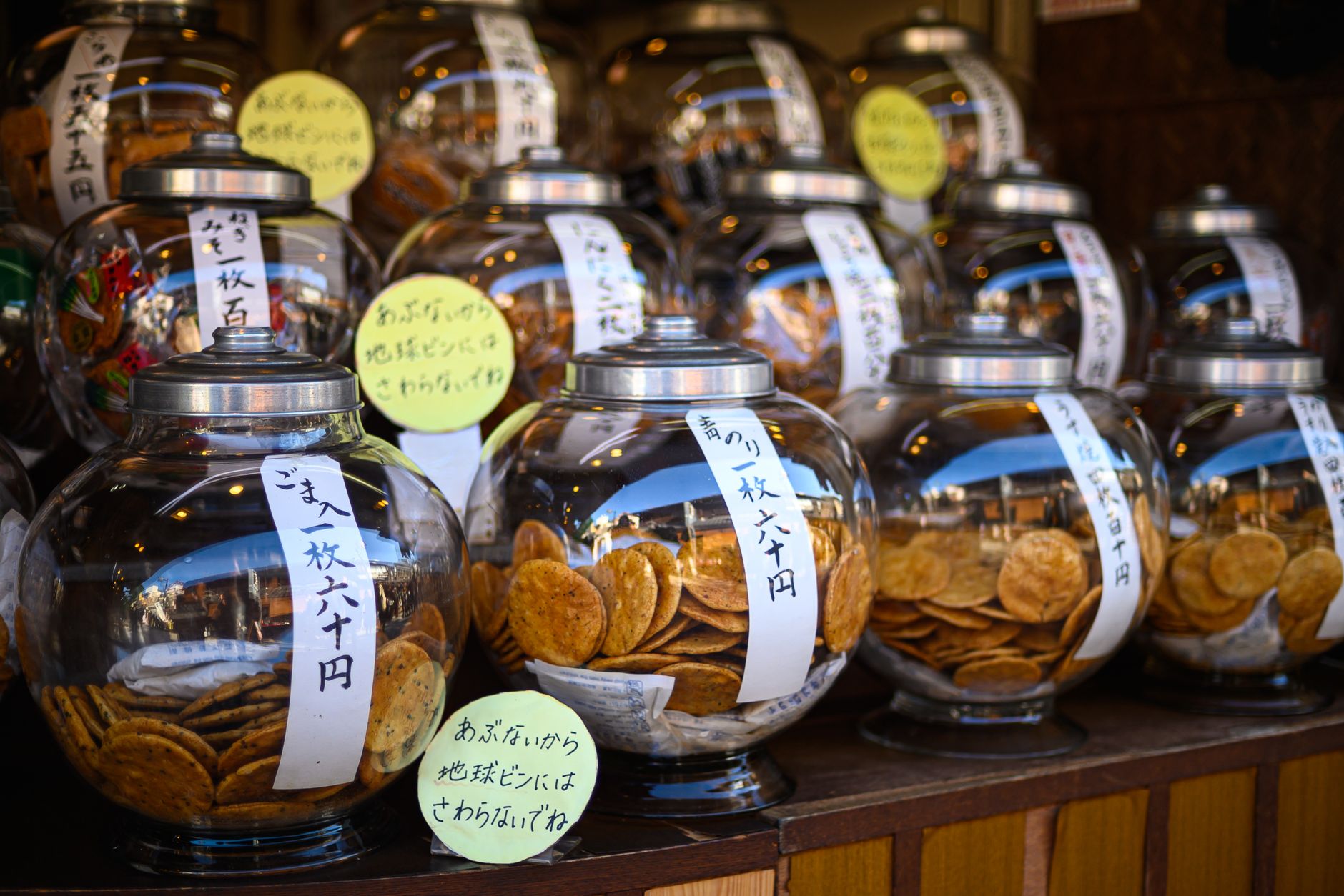
Happy Turn is a soft rice cracker dusted with Kameda Seika's signature "Happy Powder": a sweet-and-salty seasoning blend. The brand was launched in 1976, and per Kameda Seika's March 2026 press release, the standard product was renewed from mid-March 2026 for its 50th anniversary, with a revised "Happy Oil" blend.
The ingredients on the current 96g pack: non-glutinous rice (U.S.A. and Japan), edible oil and fat (食用油脂), sugar, starch, protein hydrolysate (たん白加水分解物), salt, maltose, processed starch, seasoning (amino acid), plant lecithin (contains soy).
No pork, gelatin or alcohol is listed. However, the oil is listed only as "edible oil and fat" (食用油脂), not as vegetable oil, and the source of the protein hydrolysate is not stated, Kameda Seika's FAQ explains that this ingredient can be made from plant proteins or from animal proteins such as milk. Kameda Seika also states that its products are not halal-certified. We therefore rate Happy Turn ❓ Unconfirmed.
Caveats:
- Per Kameda Seika's allergen notice on the same page, the factory also produces items containing shrimp, wheat, egg, dairy, and peanuts.
- Flavored variants have different formulations. For example, Happy Turn 大人がハマる香味スパイス contains chicken extract powder (チキンエキスパウダー), so avoid it.
- Per Kameda Seika's standard disclaimer: "ingredient details on the website may differ from the on-pack label after a recipe change. Always confirm on the package before purchase."
📱 Find halal restaurants, prayer rooms and Muslim-friendly places across Japan with the free Halal Navi app.
Download on the App Store · Get it on Google Play
At-a-glance comparison
| Snack | Manufacturer | Pork / Gelatin | Alcohol-derived flavor | Emulsifier source | Halal-certified? | Best for |
|---|---|---|---|---|---|---|
| Alfort | Bourbon | None on label | None on label | Soy-derived (allergen note); shortening origin not stated | ❌ No | Souvenir gift |
| Elise (plain) | Bourbon | None on label | None on label | Soy-derived (allergen note); processed fat origin not stated | ❌ No | Wafer lover |
| Home Pie | Fujiya | None on label | None on label | Wheat- and soy-derived (allergen note); milk-based ingredient contents not disclosed | ❌ No | Tea-time biscuit |
| Funwari Meijin Kinako Mochi | Echigo Seika | None on label | No flavoring used | None added | ❌ No | Cleanest label |
| Happy Turn | Kameda Seika | None on label | None on label | Plant lecithin; oil and protein hydrolysate origin not stated | ❌ No | Travel snack |
Funwari Meijin Kinako Mochi is best treated as ⚠ Muslim-friendly with cross-contamination risk; Home Pie, Alfort, Elise and Happy Turn are ❓ Unconfirmed. None is ✅ confirmed halal. Recipes change without notice: always re-read the on-pack label.
How to read a Japanese snack label in 30 seconds
Even if you don't read Japanese, the most relevant ingredients almost always appear with the same kanji. Scan for these red flags:
- 豚 (buta, pork): avoid
- 豚脂 / ラード (buta-shi / rādo, lard): avoid
- ゼラチン (zerachin, gelatin): avoid unless explicitly fish or halal-beef
- 酒 / みりん / 料理酒 (sake / mirin / cooking sake): avoid
- ショートニング (shōtoningu, shortening): check whether plant-derived
- 乳化剤 (nyūkazai, emulsifier),大豆由来 ("soy-derived") is an allergen notation and does not always mean every component is plant-based
- 香料 (kōryō, flavor): may be alcohol-extracted in fruit flavors; the strictest Muslims avoid
If you cannot read the label, the most useful phrase is: 「これに豚肉とお酒は入っていますか?」(Kore ni butaniku to o-sake wa haitte imasu ka?), "Does this contain pork or alcohol?" Staff may be able to help, but they often cannot know how each ingredient was made. Carry a Muslim dietary card if you want to be thorough.
Frequently Asked Questions
Are any of these snacks officially halal-certified?
We found no certification. As of 2 October 2026, none of the four manufacturers appears on NPO Japan Halal Association's public list of certified companies, none publishes a halal certificate for these products on its website, and Kameda Seika states that its products are not halal-certified. One of the five is rated ⚠ Muslim-friendly and four ❓ Unconfirmed in this guide.
Are Bourbon's shortening and emulsifier really plant-based?
Not confirmed. Bourbon's labels mark the emulsifier as soy-derived, which is an allergen notation. Alfort's label lists shortening without saying whether it is plant- or animal-based, and Bourbon's FAQ says shortening can be made from either; Elise lists processed edible fat (食用加工油脂) without stating its origin. We found no halal certification for either product.
Is the "flavor" (香料) ingredient in Japanese snacks always alcohol-based?
Not necessarily, but Japanese labels do not say whether a flavoring was made with alcohol, so the label alone cannot answer this. If you avoid even trace-alcohol flavorings, choose products with no 香料 on the label (such as Funwari Meijin Kinako Mochi) or ask the manufacturer.
Why isn't McVitie's or any other Western brand on this list?
This guide focuses on Japanese-manufactured snacks sold widely at konbini and supermarkets in Japan. Imported brands can have different formulations in different markets, so always check the label of the version sold in Japan.
Can I find halal-certified Japanese snacks anywhere?
Yes, but rarely at standard konbini. NPO Japan Halal Association lists certified soy sauce, miso, tea, and some specialty Japanese foods on its certified-company database. If you need certified products, a halal grocery store is a better place to look than a convenience store.
Are these snacks safe for children with milk or egg allergies?
That's an allergen question, not a halal question. Most of the snacks in this guide contain milk components, and Fujiya's Home Pie page declares cross-contamination with eggs at the factory. Happy Turn's factory also handles eggs, dairy, and peanuts. Read the allergen disclosure on the back of each pack before giving to allergy-sensitive children.
Has Happy Turn changed recipe recently?
Yes. Per Kameda Seika's March 2026 press release, the standard Happy Turn was renewed from mid-March 2026 for its 50th anniversary, with a revised "Happy Oil" blend. It is a reminder that Japanese snack recipes change, so re-check the package on each trip.
How current is this guide?
Every product's ingredient list in this guide was re-checked on 2 October 2026 against the manufacturer's own official product page (Bourbon, Fujiya, Echigo Seika, Kameda Seika).
Can I buy these snacks outside Japan?
Echigo Seika's brand page says Funwari Meijin has fans in South Korea, Singapore and Taiwan, some of whom buy it at local supermarkets. We have not checked overseas availability of the other snacks. Note that the export version may have a slightly different formulation, so always read the local label.
Verdict
Japanese konbini and supermarkets are a paradise of snacks, and Muslim travelers do not have to walk past every shelf. Of the five widely available snacks checked here, Echigo Seika Funwari Meijin Kinako Mochi has an official ingredient list that names only plant oils and lists no pork, gelatin or alcohol, so we rate it ⚠ Muslim-friendly. Fujiya Home Pie, Bourbon Alfort, Bourbon Elise and Kameda Seika Happy Turn list fats or other ingredients whose origin is not disclosed, so we rate them ❓ Unconfirmed. None carries halal certification.
The cleanest label of the five is Funwari Meijin Kinako Mochi, seven plant-based ingredients, no flavorings, no emulsifier and no other additives listed. If you want a single recommendation for a Japan souvenir snack, that is ours.
Final reminder: ingredient lists are a snapshot, not a guarantee. Japanese snack makers reformulate routinely, and regional and seasonal flavors of the same brand can differ significantly. Read the on-pack label every time, and when in doubt, reach for the plain variant.
For halal-certified meals and restaurants in Japan, browse Halal Navi's restaurant database, including prayer room information and community reviews.
Sources & references
- Bourbon Alfort official product page, bourbon.co.jp/product/detail/36079-01.html, accessed 2026-10-02
- Bourbon Alfort brand site, bourbon.co.jp/alfort/, accessed 2026-10-02
- Bourbon Elise (32-stick) product page, bourbon.co.jp/product/detail/36075-01.html, accessed 2026-10-02
- Bourbon FAQ: What is shortening?, customer-support.bourbon.co.jp/hc/ja/articles/5050509136414, accessed 2026-10-02
- Fujiya 38-piece Home Pie product page, fujiya-peko.co.jp/sweets/item/27811.html, accessed 2026-10-02
- Fujiya Home Pie brand site, fujiya-peko.co.jp/homepie/, accessed 2026-10-02
- Echigo Seika Funwari Meijin Kinako Mochi product page, echigoseika.co.jp/products/174/, accessed 2026-10-02
- Echigo Seika Funwari Meijin brand site, echigoseika.co.jp/funwari/, accessed 2026-10-02
- Echigo Seika FAQ, echigoseika.co.jp/faq/, accessed 2026-10-02
- Kameda Seika 96g Happy Turn product page, kamedaseika.co.jp/product/1415/, accessed 2026-10-02
- Kameda Seika Happy Turn 香味スパイス product page, kamedaseika.co.jp/product/2211/, accessed 2026-10-02
- Kameda Seika FAQ (halal certification; protein hydrolysate), kamedaseika.co.jp/customer/faq/, accessed 2026-10-02
- Kameda Seika "Happy Turn 50th-anniversary renewal" press release, 16 March 2026, kamedaseika.co.jp/news/20260310_25455/, accessed 2026-10-02
- NPO Japan Halal Association list of certified companies, jhalal.com/en/halal-cert-en/halalco_list-en, accessed 2026-10-02
- NPO Japan Halal Association certification framework, jhalal.com/en/halal-cert-en/type-of-halal-cert-en, accessed 2026-10-02
About this article
Written and halal-verified by Zeshan Hayat, CMO & Head Halal Auditor, Halal Navi.
Reviewer: This article was reviewed by Halal Navi's Halal Verification Team, which cross-checks each ingredient claim against the cited manufacturer's primary source before publication. See our editorial standards for the full review process.
Update policy: If you find a recipe change on a pack that differs from this article, we will review and correct it within 7 days.
Disclosure: Halal Navi receives no payment from any restaurant or hotel in exchange for inclusion, and all recommendations reflect independent editorial judgment based on Muslim-friendly criteria. Some articles contain affiliate booking links (e.g. Trip.com); if you book through one, Halal Navi may earn a small commission at no extra cost to you.
Last verified: 2026-10-02
🛒 Once you know what is safe to buy, the next question is where. We list halal grocery stores and halal-friendly supermarkets across Japan.
Find halal groceries in Japan →