

Halal Food in Okayama 2026: The Peach Mark, and What It Actually Means
Quick Answer: Okayama has its own Muslim-friendly scheme, the Peach Mark, run by the Okayama Health Tourism Cooperation Council with Okayama City. It is not halal certification. Level I means an English menu and pork-free dishes; Level II adds no alcohol and dishes made with meat that carries halal certification. That certification belongs to the meat supplier, not to the restaurant. Separately, Koeido's kibi dango carries genuine halal certification from the Japan Islamic Culture Center — the first dango in Japan to hold it, since December 2014. Hotel Granvia Okayama is Peach Mark II and has a dedicated prayer room on the 2nd floor with a mat and qibla compass. Among the restaurants, Megu has the clearest basis: its beef carries Australian halal certification, though alcohol is served and the kitchen is not separated.
Okayama is not on most Muslim travel routes through Japan, and the city has quietly built something unusual to change that: its own certification-shaped scheme. Understanding exactly what it covers — and what it does not — is the difference between a good trip and an uncomfortable one.
What the Peach Mark is
The Peach Mark (ピーチマーク) was created by the Okayama Health Tourism Cooperation Council (岡山型ヘルスツーリズム連携協議会), a body formed in 2016 with Okayama City, Maniwa City, Kibichuo Town and local tourism organisations. The secretariat sits inside Okayama City's tourism division.
It covers restaurants, accommodation and manufacturers, in two levels.
| Peach Mark I | Peach Mark II | |
|---|---|---|
| English menu | ✅ | ✅ |
| Pork-free dishes | ✅ | ✅ |
| Alcohol-free dishes | — | ✅ |
| Dishes made with halal-certified meat | — | ✅ |
| Accommodation adds | English-speaking staff, prayer facilities | — |
This is the part that matters. Peach Mark II requires dishes made with halal-certified meat. That is a statement about the meat supplier, not about the restaurant. The kitchen itself is not audited, and no certifying body issues a certificate to the venue. A Peach Mark II restaurant is not a halal-certified restaurant.
If you need certification at the venue level, the Peach Mark does not give it to you. If you are comfortable with pork-free and alcohol-free cooking using certified meat, it tells you exactly which places have committed to that — which is more than most Japanese cities publish at all.
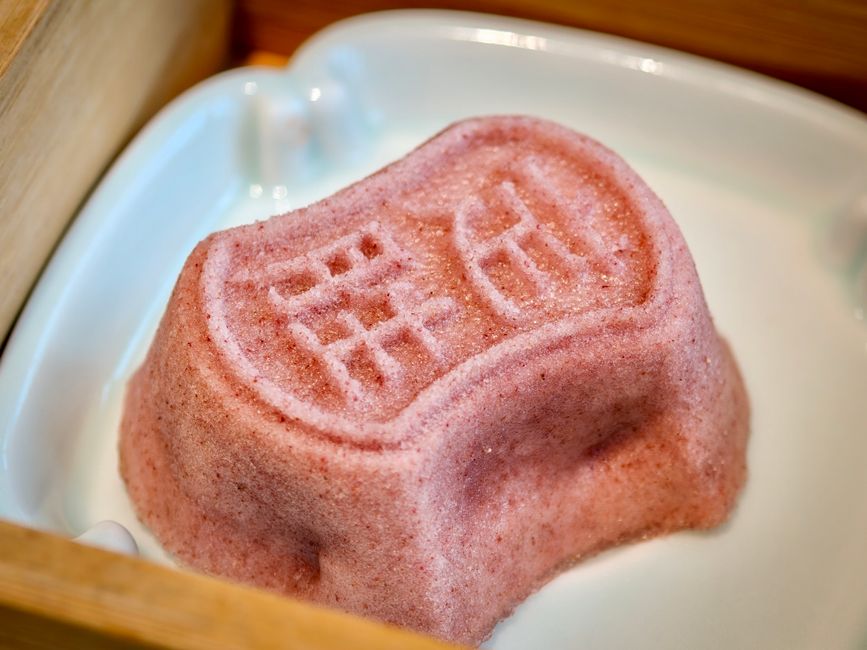
Traditional Japanese wagashi. Okayama's version is kibi dango, tied to the Momotaro tale. Illustrative photo — not Koeido's certified boxes. Photo by Teresa Wang on Pexels (https://www.pexels.com/photo/close-up-of-traditional-japanese-wagashi-confectionery-35470288/)
The one thing in Okayama that is certified: Koeido's kibi dango
Koeido (廣榮堂), a confectioner founded in 1856, makes kibi dango — the millet dumpling tied to the Momotaro folk tale, and Okayama's defining souvenir.
In December 2014 the company obtained halal certification from the Japan Islamic Culture Center for eight of its products. It was the first dango in Japan to hold halal certification. The certified line-up:
- 元祖きびだんご (original)
- 黒糖きびだんご (brown sugar)
- 海塩入りきびだんご (sea salt)
- 白桃きびだんご (white peach)
- きなこきびだんご (kinako)
- 玄米きびだんご (brown rice)
- 紅白きびだんご (red and white)
- むかし吉備団子 (mukashi kibi dango)
This is a named body, a named date, and a named product list — the three things a halal claim needs and usually does not have in Japan. If you take one thing home from Okayama, this is the one you can be sure about.
Note the limit of the claim: it is the products that are certified, in the factory. Confirm at the counter that the box you are buying is one of the certified lines.

A hotel room in Japan. Illustrative — not Hotel Granvia Okayama itself. Photo by Daisuke Fujita on Pexels (https://www.pexels.com/photo/a-couch-near-a-bed-in-a-hotel-room-4493299/)
Where to stay: Hotel Granvia Okayama
Hotel Granvia Okayama, at Okayama Station, is a Peach Mark II certified hotel — its own site says so.
From the hotel's own page:
- Prayer room: 「お祈りマットとキブラコンパスを常設したお祈り専用ルームが2階にございます」 — a dedicated prayer room on the 2nd floor, with a prayer mat and qibla compass permanently in place
- Dinner: a Muslim-friendly menu at Dining & Bar Applause on the 19th floor — the hotel's own page lists it at 「¥5,000(消費税・サービス料込み)」. Prices move; confirm when you book
- What the menu excludes: 「アルコール・豚肉を使用しないメニューをご用意しております」 — no alcohol, no pork
What the page does not say: opening hours for the prayer room, whether wudu facilities are available, or how far ahead the Muslim-friendly dinner must be booked. Ask when you reserve.
Being on top of Okayama Station matters more here than in a bigger city — Okayama is a transit hub for the Seto Inland Sea, Kurashiki and Shikoku, and you will be moving through the station repeatedly.

Sliced beef for shabu-shabu. Illustrative — not photographed at Megu. Photo by J-Steve Pham on Pexels (https://www.pexels.com/photo/close-up-of-freshly-sliced-beef-on-ice-35834167/)
Eating in Okayama
Okayama's Muslim-friendly dining is small enough to name individually — and the differences between these places matter more than the number of them.
Shabu-shabu Sukiyaki Hitorinabe Megu is the most documented. The operator's own site states the beef carries Australian halal certification, which we checked in August 2026. That is certification of the beef, not of the restaurant — and alcohol is served on the premises. So: halal ingredients, but the kitchen is not separated, which leaves cross-contamination on the table as a question you have to ask. Book the day before, and confirm directly with the restaurant that the beef served to you is the certified one and that your pot is not shared with non-halal orders.
Milenga (インド家庭料理 ミレンガ) — Indian home cooking near Okayama Station, open since 2015. The restaurant describes itself in its own words as 「ハラールのインド料理店」 — a halal Indian restaurant. That is the shop's own description of itself; no certifying body is named.
It is also shut at the moment. The Oka Building it occupied at 1-3-3 Nodayacho is being redeveloped, and the restaurant closed there on 31 July 2026. Its own Instagram announced a reopening on 1 September 2026 at a new address a few minutes away — 2-5-7 Nodayacho, Kita Ward — and Google lists that address as not yet open, which matches. If you are in Okayama before September, do not plan around it. After that, confirm directly with the restaurant that it has reopened, and ask the staff about the kitchen. A prayer space was reported at the old shop, primarily for staff; whether the new one has it is unknown.
Camel Kitchen and Halal Arena in Kita Ward is listed as halal on the strength of visitor reports rather than an operator statement. Not verified — ask when you go.
A handful of other places in the city are listed as halal but we have not visited them, including RYOUTEI and a venue listed simply as Halal Restaurant. See halal restaurants in Okayama on Halal Navi for the current list — there are nine at the time of writing.
Two questions worth asking wherever you eat: which certifying body, if any, and whether the kitchen also cooks non-halal.

A Japanese landscape garden in autumn — this one in Kyoto, not Korakuen. Korakuen itself sits beside Okayama Castle. Photo by Nizar F on Pexels (https://www.pexels.com/photo/autumn-serenity-in-kyoto-s-scenic-garden-34580426/)
What else to do
The classic Okayama day works without any special arrangement:
- Korakuen Garden — one of the three great gardens of Japan, next to the castle
- Okayama Castle — the black keep, with a boat tour on the Asahi River
- Tomomien Farm — white peach picking in season. Okayama peaches are the reason the Peach Mark is a peach
None of these involves food you need to check, which makes Okayama an easy place to build a day around a single verified meal.
Frequently Asked Questions
Is the Peach Mark a halal certification?
No. It is a Muslim-friendly scheme run by a regional tourism council, not a certifying body. Level II requires dishes made with halal-certified meat, but the certification belongs to the meat supplier — the restaurant kitchen is not audited and receives no certificate.
What is the difference between Peach Mark I and II?
Level I: English menu and pork-free dishes. Level II adds alcohol-free dishes and the use of halal-certified meat. For accommodation, Level I also requires English-speaking staff and prayer facilities.
Is there halal-certified food in Okayama?
Yes — Koeido's kibi dango. Eight products have held certification from the Japan Islamic Culture Center since December 2014, the first dango in Japan to do so. Check that the specific box you buy is one of the certified lines.
Where can I pray in Okayama?
Hotel Granvia Okayama has a dedicated prayer room on the 2nd floor with a mat and qibla compass. That is the only one you can rely on right now — Milenga had a reported prayer space, but it is closed until its September 2026 reopening. Okayama has no mosque listed on Halal Navi — the nearest listed prayer facilities are in Osaka and Kyoto, so plan your prayers around the hotel while you are here.
Is Okayama worth a detour for a Muslim traveler?
If you are already moving between Osaka and Hiroshima, yes — it is on the Sanyo Shinkansen and the certified sweets are unique to the city. As a destination in its own right, the Muslim-friendly infrastructure is still thin: one hotel with a prayer room and a handful of restaurants.
Verdict
Okayama is honest about what it offers, and that is rare. The Peach Mark does not pretend to be halal certification — it publishes its criteria, and the criteria are modest and checkable. Koeido's kibi dango is the real thing, with a named certifier and a named product list.
Plan it as a stop rather than a base: stay at Granvia for the prayer room, buy the certified kibi dango, and confirm any restaurant directly before you rely on it.
Sources
- Okayama Health Tourism — Peach Mark criteria for Levels I and II
- Hotel Granvia Okayama — Muslim-friendly services — Peach Mark II status, prayer room, dinner menu
- Koeido — kibi dango product pages and company history
- Koeido halal certification announcement, December 2014 — Japan Islamic Culture Center, eight products
- Gogai Net Okayama, 15 August 2026 — Milenga closed 31 July 2026 for redevelopment, reopening 1 September 2026 at 2-5-7 Nodayacho
- Our own coverage of Okayama on @navito_halal
Want to see where a local creator has actually eaten? Navito's list of halal places in Japan collects the venues he has filmed, each shown with its current halal status.
About this article
Written and fact-checked by the Halal Navi editorial team, August 2026. Halal status changes — schemes are revised, restaurants change suppliers, and certifications lapse. Confirm directly with each venue before you rely on it, and tell us if you find something out of date.


