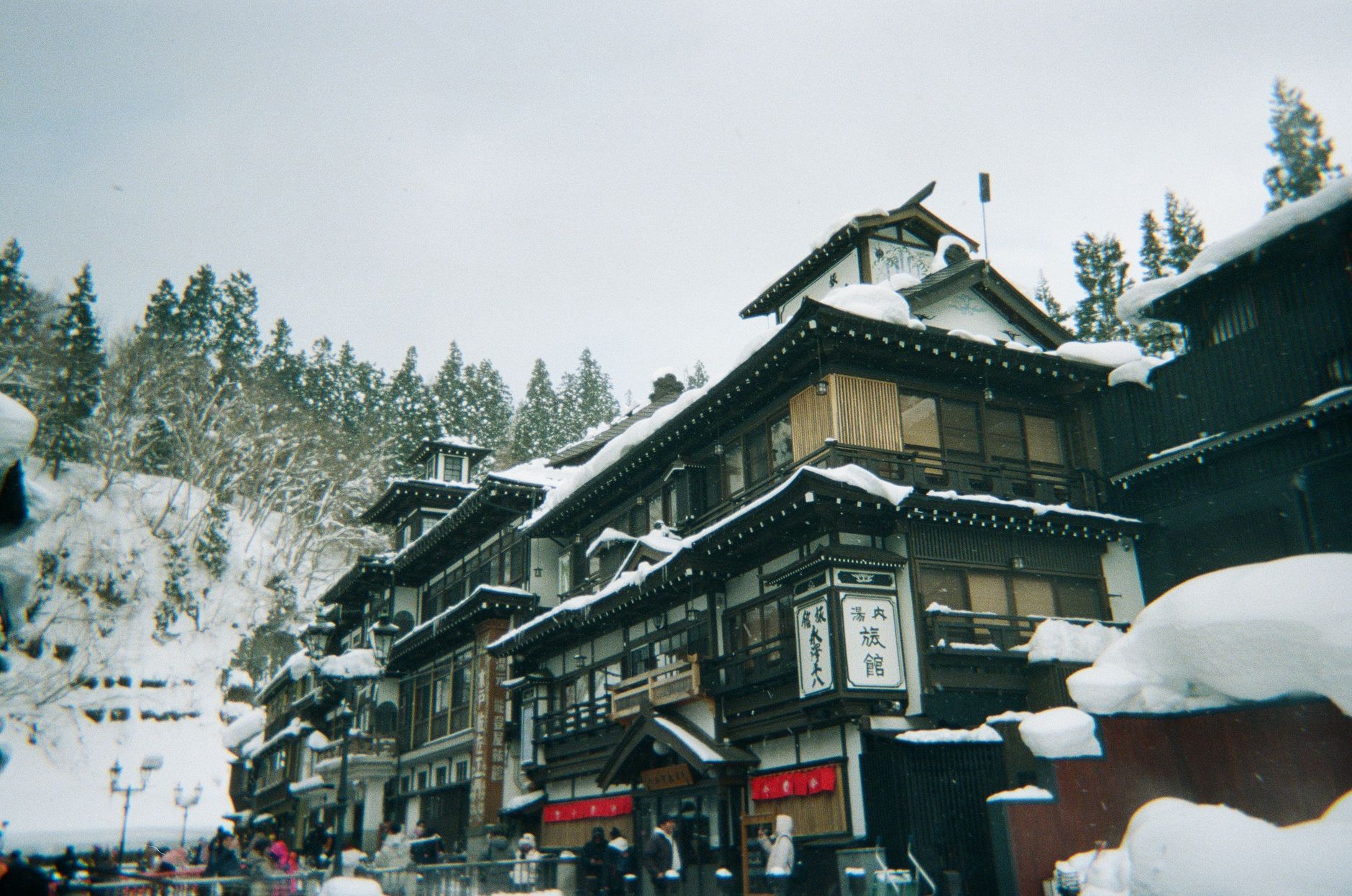
Onsen Without the Communal Bath: 10 Private-Bath Stays (2026)
Quick Answer: Japanese public baths are communal and unclothed, which rules out the standard onsen experience for many Muslim travelers. The way around it is a bath you use alone: either a kashikiri-buro you book for your group, or a bath attached to your own room or cottage. We checked ten stays on Halal Navi against their own websites in August 2026. Five of them are clustered around Lake Kawaguchi, within walking distance of a mosque and a certified halal restaurant, which makes that one area the easiest place in Japan to solve bathing, prayer and food at once. Only three of the ten use real hot-spring water: AWAUMI at Kawaguchiko, Otaru Kourakuen in Hokkaido, and fifteen specific rooms at Hotel Milione. The rest heat ordinary water, which is fine, but it is not an onsen and we are not going to call it one.
Bathing is where a Japan trip quietly stops working for a lot of Muslim visitors. The country's whole bathing culture, the ryokan, the mountain town, the thing everyone tells you not to miss, is built around a shared room where nobody wears anything. You can read every guide to Japan and still arrive without a workable answer.
There is one, and it is ordinary: book a bath you have to yourself. We wrote about the general approach in our Beppu guide but deliberately did not name specific properties there, because arrangements change and we had not checked them. This guide is that check.
The two kinds of private bath
They solve the same problem and cost very different amounts, so it is worth knowing which one you are booking.
| What it is | How you get it | |
|---|---|---|
| A kashikiri-buro | A bath the property has, which you reserve for your group's exclusive use | Book a slot. Usually 50-60 minutes, often paid on top of the room |
| Room or cottage bath | A bath attached to your own room, used only by you | Book that specific room type. Almost always included in the rate |
The second is simpler and there is no clock running. The catch is that it usually exists in only a handful of a hotel's room types, and if you book the wrong one you arrive to a normal bathroom. Every entry below says which room types actually have it.
"Onsen" is a separate question
A bath being private tells you nothing about the water. Several properties in this guide have beautiful open-air baths filled with heated ordinary water: one describes its own water as jinkō onsen, artificial hot spring, and another as hakusan no fukuryūsui wo wakashita yu, boiled spring water from Mount Hakusan, not a hot spring. That is not a criticism of those places. It only matters because "private onsen" is what people search for, and three of these ten are the real thing.
Kawaguchiko: the one place where everything lines up

Lake Kawaguchi looking toward Mount Fuji. The stays in this section are spread along the far shore. Photo by Andrey Grushnikov on Pexels
Five of the ten are within a few kilometres of each other on the north side of Lake Kawaguchi, under Mount Fuji. That clustering matters more than it sounds, because the same small area also has:
- Fujikawaguchiko Masjid, about 1 km from most of these properties
- a prayer room with wudu facilities at Syariah Hotel Fujisan, about 800 m
- IDATEN BETTEI Honten, a Japanese kaiseki restaurant about 1 km away, certified by the Japan Halal Certification Promotion Organization in August 2025, with no pork, alcohol or mirin used
- four more halal and Muslim-friendly places within 1.5 km
Most of these stays are whole cottages with full kitchens, so you can also cook. For where to eat around the lake and up toward Hakone, we have a separate Mount Fuji food guide.
AWAUMI Fujikawaguchiko Resort: the one that is genuinely an onsen
AWAUMI is the clearest case in this guide. All sixteen cabins have their own hot-spring bath, and the property names its source: Shūrei no Yu, one of the springs of the Fujikawaguchiko onsen district, a calcium-sodium chloride spring that the operator describes as slow to cool. Each cabin also has a private Finnish-style sauna in Japanese cypress, with a cold plunge on the terrace.
You use it whenever you want between check-in at 15:00 and check-out, with nothing to book and nothing extra to pay. Cabins come in four styles, suite villa, dog villa, dome tent and private cabin, and the bath is in all of them. Kitchens have a full set of cookware, a microwave and a fridge-freezer; salt and pepper are the only seasonings provided, so bring what you need. There is a glassed-in BBQ room for wet weather.
Nearest mosque 951 m. Nearest halal restaurant 543 m. Full details on AWAUMI's Halal Navi page.
Cottage Superba Vista: the property that says it out loud
Superba Vista is five cottages, each with both an indoor bath and its own open-air bath. The Japanese site puts the point plainly:
各棟ごとに専用露天風呂があります。女性のお客様も安心して入浴出来ます。 Every cottage has its own open-air bath. Women can bathe with peace of mind.
That is the operator's own framing, not ours, and it is unusual to see a Japanese property name the concern directly. There is no charge and no booking: the bath is yours for the stay. Each cottage has a full kitchen with an IH hob, rice cooker, microwave and a complete set of pans and dishes.
One thing to know: the property notes that in December through February, weather can make the open-air bath unusable on some days.
The water is not a hot spring. The site never uses the word.
Kawaguchiko Villa FJ Resort: open-air bath upstairs, kitchen downstairs
Four maisonette cottages, 89 m², sleeping up to eight. Kitchen and living space downstairs; the open-air bath and bedrooms upstairs. The kitchen is the most complete of the five here: IH hob, rice cooker, microwave, toaster oven, kettle, coffee machine, and a full run of pans, knives, boards and dishes.
Check-in runs 15:00-21:00 and check-out is 10:00. Front desk hours are 08:30-20:30, and they run a shuttle to Kawaguchiko station and the Fuji-Q area.
A caveat on our own sourcing: the official site describes the room only as having "a washbasin, bathroom and so on". The open-air bath is documented in the property's own listing data and photo captions on Jalan rather than on its website. We are confident it exists; we could not confirm the details from the operator's own pages.
Pension Lovin' Spoonful: two baths, no clock, no charge
This is the only true kashikiri arrangement among the Kawaguchiko five, and the most relaxed version of it. The pension has two private baths, available whenever they are free: you lock the door from the inside. No reservation, no time limit, no fee, though the owners ask guests to be considerate when the house is full.
The water is jinkō bakuhanseki onsen, an artificial bath using bakuhanseki stone. The property's own listing data records "hot spring: none". It is a nice bath; it is not an onsen.
Seven rooms, a cafe on site serving house-baked bread and cakes from 11:30, and check-in as late as 24:00, which is unusually forgiving. Booking and enquiries are by phone only, up to 23:00.
Villa Sankando: a whole house, and an honest gap
Sankando is a single detached villa rented to one group at a time, so by definition nobody else is using the bath. Beyond that we have to be straight with you: the operator's site lists "bath" and nothing else. Not whether it is indoor or open-air, not the size, not the water.
The site's front page mentions that hot springs can be enjoyed nearby, which refers to public onsen facilities in the area, not to the villa's own bath. We flag that because it is exactly the kind of line that gets misread.
Kitchen has pans, knives, boards and dishes, with oil, salt, pepper and soy sauce provided. Check-in 15:00-21:00.
Ueno: private baths in the middle of Tokyo
If the point of the trip is Tokyo rather than a mountain, two hotels a few streets apart in Ueno have open-air baths built into specific rooms. The area around them is the densest halal food district in the country: 63 halal restaurants within 2 km, the closest about 100 m away, and Assalam Mosque Okachimachi under 500 m. Our Asakusa and Ueno food guide covers what to eat there.
The two hotels have nearly the same name and are not the same place, so check which one you are booking.
Centurion Hotel & Spa Ueno Station
This one has three room types with a private open-air bath: Executive Twin, Deluxe Family and Comfort Twin, in the main building. The annex rooms do not have one. Ninety-three rooms in total, so the bath rooms are a small share of them: book the room type, not the hotel.
The hotel also has a large shared bath it calls Tenshō Radium Onsen, and here the wording matters. The property describes it as an artificial radium bath, not a natural hot spring. Whether the in-room baths use the same water is not stated anywhere on the site.
The shared bath is free for guests and open around the clock except for cleaning between 02:00 and 04:00. It does not accept guests with tattoos. There is a yakiniku restaurant in the building; the site does not say what it serves regarding pork or alcohol, so ask.
Centurion Hotel Ueno
The other Centurion has no shared bath at all, which for this guide is a point in its favour: there is no communal facility you are opting out of. Four of its twenty-one room types come with a private open-air bath: Wa-Suite Miyabi (about 30 m², up to 8 people), Murasaki Shikibu (26 m², up to 7), Kaguya (21 m², up to 4) in the annex, and Wa-Suite Sakura/Fuji (38 m², up to 7) in the main building. The other seventeen types do not.
Nothing on the site describes the water as a hot spring, and the brand name that the sister hotel uses does not appear here at all.
Hokkaido and Ishikawa: excellent baths, bring your own food
Three properties outside the cities have the best baths in this guide. They also have the hardest food and prayer situation, and we would rather say so here than let you discover it on arrival.
| Nearest halal restaurant we list | Nearest mosque or prayer room | |
|---|---|---|
| Otaru Kourakuen | 5.0 km | 6.1 km |
| Hotel Milione, Jozankei | 16.1 km | 16.4 km |
| Ichirino Kogen Roan | 33.0 km | 31.9 km |
None of these are walkable. Plan meals before you go.
Otaru Kourakuen: the most complete answer in this guide
Kourakuen has its own spring on the property. It draws about 80 tonnes a day from 500 m down, a pH 8.4 alkaline simple spring at 27 °C, which is why it is heated and circulated; the operator states it adds no tap water.
You can get at that water two ways. The private bath you reserve, kokage no ideyu, "the bath in the shade", is 80 m² with an indoor bath, a sauna and a cold plunge, and a changing area with sofas and a television. It runs ¥3,300 for 60 minutes, plus ¥550 per additional 10 minutes up to 90. You can book it in advance as a stay option, or ask at the front desk after check-in, subject to availability. Slots run 15:00-24:00 and 06:00-11:00, plus 12:00-14:00 if you are staying more than one night.
Separately, 28 of the 34 rooms have their own open-air bath, included in the rate, usable whenever you like.
This is also the only property in this guide with a Muslim-facing page of its own. From it:
ハラール食材につきましては、ハラール許可食肉を含む認証食材を仕入れ、調理しております。ムスリムフレンドリーメニューの準備・調理・保管は独立した専門房内で行い、調理器具・食器はハラール専用を使用しております。殺菌処理にもアルコールは用いておりません。 We buy in certified ingredients including halal-permitted meat. Muslim-friendly meals are prepared, cooked and stored in a separate dedicated room, using cookware and tableware reserved for halal. No alcohol is used in sterilising either.
The rooms come with a prayer mat and a qibla marker, and the property points out that rooms with an open-air bath have a shower room, which is convenient before prayer. Kaiseki using halal ingredients is available. As with any operator statement, this is the property describing itself rather than a certification, so confirm the arrangement when you book. Our listing for Otaru Kourakuen has the rest of the detail.
On tattoos: Kourakuen states that guests with tattoos may not use the large shared baths and their open-air areas, and explicitly says this applies even where the tattoo is for religious or cultural reasons. The wording does not say whether the same rule reaches the private rented bath or the in-room baths, and the FAQ treats those as separate facilities. If it affects you, ask before booking rather than on the day.
Hotel Milione, Jozankei: read the room type very carefully
Milione is a 296-room hot-spring hotel, and its own FAQ draws a line that is easy to miss:
温泉展望風呂付客室:…お風呂のお湯は温泉です。/サウナ付客室・和室・洋室:…お風呂のお湯は温泉ではなく、沸かし湯です。 Rooms with an onsen view bath: the water is hot-spring water. Rooms with a sauna, Japanese-style rooms, Western-style rooms: the water is not hot-spring water, it is heated water.
So 15 rooms out of 296 give you hot-spring water in private. Everything else is a normal bath. The FAQ also notes that the onsen view bath is not open-air: it is an indoor bath with a view. Book the wrong category and you have neither.
The shared bath, Bisen, is around 450 m² with an auto-löyly sauna and two cold plunges. It refuses entry to guests with tattoos, including temporary and painted ones. Alcohol is served at the dining venues, including an all-you-can-drink option.
Ichirino Kogen Hotel Roan: two private baths, and it says plainly it is not an onsen
Roan in the mountains of Ishikawa has two bookable private baths: a rock-built open-air bath at ¥3,190 for 50 minutes and an all-cypress indoor bath at ¥2,620 for 50 minutes. Both are reserved in advance, starting on the hour, 11:00-22:00. There is also a Suite with its own rock open-air bath, included in the rate.
The hotel states its water is boiled spring water from Mount Hakusan and is not a hot spring. We are repeating it because a mountain hotel with rock open-air baths reads like an onsen and this one tells you it is not.
Two practical notes. The hotel sells sake and beer to drink in the private baths, so alcohol is present in the building. And this is the most isolated property here: the nearest halal restaurant we list is 33 km away.
📱 Find halal restaurants, prayer rooms and Muslim-friendly places across Japan with the free Halal Navi app.
Download on the App Store · Get it on Google Play
What we could not confirm
Being straight about the gaps is more useful than a clean-looking list.
- Villa Sankando: the operator lists "bath" and nothing more. Indoor or open-air is unknown.
- Kawaguchiko Villa FJ Resort: the open-air bath is documented in the property's listing data, not on its own website.
- Both Centurion hotels: neither states what water the in-room open-air baths use.
- Tattoo rules at Kourakuen and Roan: Kourakuen's rule is written for the shared baths and it is unclear whether it extends to private ones. Roan's site has no tattoo policy at all, which is not the same as permission.
Where a property has not written something down, ask it directly. Every one of these takes bookings by phone or email.
FAQ
Can Muslim travelers use an onsen in Japan? Not the standard version: public baths are communal and unclothed. The workable alternative is a private bath: either a kashikiri-buro you reserve for your group, or a bath attached to your own room or cottage. Both exist widely; they are just rarely presented as the answer to this particular question.
Which of these are actually hot springs? Three. AWAUMI at Kawaguchiko (source named Shūrei no Yu), Otaru Kourakuen (its own spring, pH 8.4), and the 15 onsen-view rooms at Hotel Milione. Everything else heats ordinary water, including two properties that say so on their own sites.
What does a private bath cost? It depends which kind. A bath attached to your room or cottage is normally included: you pay for the room type. A bath you reserve separately runs roughly ¥2,600-3,300 for 50-60 minutes at the properties here. Lovin' Spoonful is the exception: its two private baths are free and have no time limit.
Where is the easiest place to do all of this in one trip? Lake Kawaguchi. Five of these ten stays are there, and the same area has a mosque about 1 km away, a restaurant certified by the Japan Halal Certification Promotion Organization, and several more halal places within 1.5 km. Most of the cottages have full kitchens as well.
I have a tattoo. Does that change anything? For shared baths, often yes: two properties here refuse entry, and one states the rule applies even when the tattoo is religious or cultural. A private bath sidesteps the situation, but not every property has written down whether its rule covers private baths too. Ask when you book.
Are the meals at these places halal? Only Otaru Kourakuen makes a detailed statement about it, and that is the operator describing its own kitchen rather than a certification. Milione and Roan both serve alcohol on site. Most of the Kawaguchiko cottages have full kitchens, which for many travelers is the more reliable route: buy your own ingredients and cook.
In short
If you want a hot spring and privacy in the same booking, there are three properties in this guide and one of them, AWAUMI, gives it to every cabin with a private sauna attached. If what you want is a bath nobody else is using, there are ten, and five sit within walking distance of a mosque and a certified restaurant.
The rest of the country has these arrangements too: they are ordinary in Japan, just badly signposted in English. When you find a property you like, the question to ask is short: kashikiri-buro wa arimasu ka, do you have a private bath? For everything currently on our map, see Muslim-friendly stays in Japan on Halal Navi.
About this article
Written and halal-verified by Zeshan Hayat, CMO & Head Halal Auditor, Halal Navi.
Update policy: If you spot outdated information, we will review and correct it within 7 days.
Disclosure: Halal Navi receives no payment from any restaurant or hotel in exchange for inclusion, and all recommendations reflect independent editorial judgment based on Muslim-friendly criteria. Some articles contain affiliate booking links (e.g. Trip.com); if you book through one, Halal Navi may earn a small commission at no extra cost to you.
Last verified: 2026-08-30