How to Eat Halal in Japan With Confidence: The Practical System
Quick Answer: Eating halal in Japan works best as a plan. Choose restaurants by tier (certified and alcohol-free, certified with alcohol served, or uncertified "Muslim-friendly"). At uncertified places, ask six precise questions in Japanese. In shops, read the label for 豚肉, ラード, ゼラチン, エキス, 酒 and みりん. The night before, mark a certified lunch, a certified dinner and a place to pray on your map.
Part 3 of 3. Reading a certificate, reading a label, the six questions to ask in Japanese, and how to plan a day so you're never deciding hungry. Checked October 2026.
This series: Part 1: Halal is more than "no pork" · Part 2: Cross-contamination in Japanese kitchens · Part 3: How to eat halal in Japan with confidence (this article)
Halal food in Japan is a planning problem.
It isn't a shortage problem any more. Tokyo, Osaka and Kyoto now have certified ramen shops, sushi counters and wagyu grills. The difficulty is that they're rarely where you happen to be standing at the moment you get hungry, and the ordinary restaurant in front of you can't answer the question you need answered.
Parts 1 and 2 gave you the thinking: what najasah and tayyib mean, and why the fryer matters more than the menu. This part is the method. Four tools, in the order you'll use them.
The system at a glance
| Step | Tool | When you use it |
|---|---|---|
| 1 | The three tiers | Choosing a restaurant |
| 2 | The six questions | Standing in an uncertified one |
| 3 | The label list | In a shop or convenience store |
| 4 | The day plan | The night before |
Tool 1: the three tiers
Every place that feeds Muslims in Japan falls into one of three groups. They are not the same thing, and plenty of websites blur them.
| Tier | What it means | What you still check |
|---|---|---|
| Certified, alcohol-free | A named body has audited ingredients, suppliers and kitchen; no alcohol sold | That the certificate is current |
| Certified, alcohol served | Audited food or kitchen; alcohol on the drinks menu | Whether you're comfortable with that; which part is certified |
| "Muslim-friendly", uncertified | The owner's own claim. Can be excellent, can be a sticker | Everything. See Tool 2 |
We won't tell you which tiers to accept. We will tell you to know which one you're sitting in.
Name the body
Our rule: if a restaurant names its certifying body, take it seriously. If it says "halal available" and can't tell you who says so, that earns a question mark.
Names you'll see on certificates in Japan include the Japan Muslim Association, Japan Islamic Trust, Japan Halal Foundation, Japan Halal Association, the Kyoto Council for Sharia and Halal Affairs and the Nippon Asia Halal Association (NAHA).
Three things to read on the certificate itself:
- Who issued it. A named organisation, not a generic logo.
- The expiry date. Certificates lapse, and nobody takes the frame down.
- The scope. Some cover the whole kitchen. Some cover a single dish or just the meat supply.
⚠️ "Halal meat used" is not "halal restaurant". A place can buy certified chicken and cook it next to pork in shared oil. Parts 1 and 2 explain why that matters. The meat's certificate tells you about the meat.
Tool 2: the six questions
For uncertified places. Japanese staff will usually answer precisely or go and find out. Vague questions get vague kindness, so ask these.
| Ask | Japanese | Say it |
|---|---|---|
| Is the meat halal? | お肉はハラルですか? | Oniku wa hararu desu ka? |
| Is there pork or alcohol in this dish? | この料理に豚肉やお酒は入っていますか? | Kono ryōri ni butaniku ya osake wa haitte imasu ka? |
| Is the frying oil shared with meat? | この料理は、肉と同じ油で揚げていますか? | Kono ryōri wa, niku to onaji abura de agete imasu ka? |
| Does the soup use pork or chicken stock? | スープに豚や鶏のだしは使っていますか? | Sūpu ni buta ya tori no dashi wa tsukatte imasu ka? |
| Do you use mirin or cooking sake? | みりんや料理酒は使っていますか? | Mirin ya ryōrishu wa tsukatte imasu ka? |
| Do you have halal certification? From whom? | ハラル認証はありますか?どちらの団体の認証ですか? | Hararu ninshō wa arimasu ka? Dochira no dantai no ninshō desu ka? |
Your pronunciation doesn't need to be good. Show the Japanese on your phone. Everyone does.
If the answer is a long pause followed by "maybe OK", that's a no. It's a polite no, offered by someone who doesn't want to disappoint you. Thank them and leave.
💡 The pairing that saves the most time. Carry a printed dietary card alongside the questions. The card states your whole standard in Japanese in one go, and the questions handle the follow-up. A card on its own often gets a polite nod. Questions on their own take longer. Together they get you a clear answer quickly. Halal Navi publishes a free card.
Tool 3: the label list
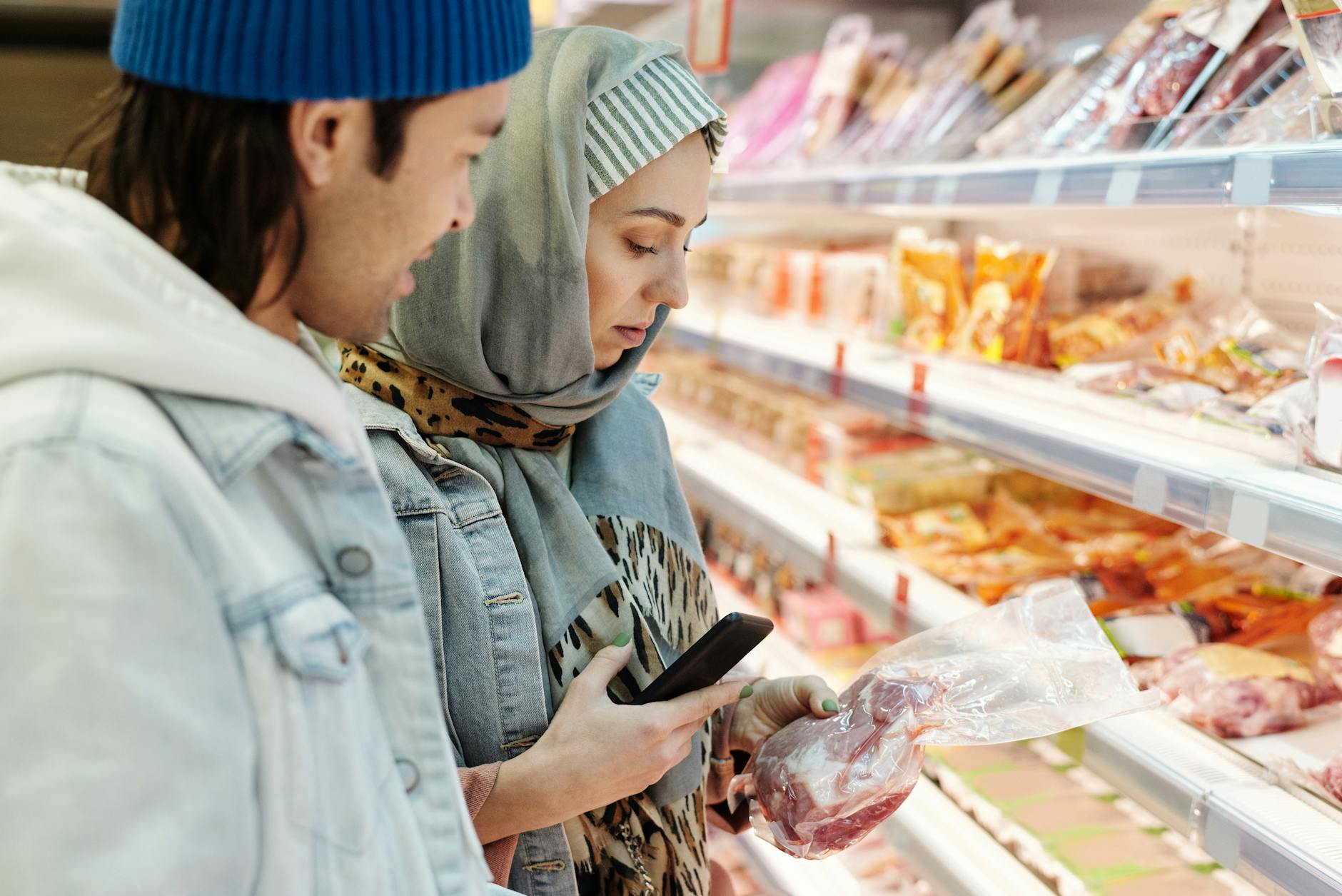
For shops, supermarkets and the chilled shelves in convenience stores. Turn the packet over and find the ingredients box, marked 原材料名.
| On the label | Reads as | Meaning |
|---|---|---|
| 豚肉 / ポーク | butaniku / pōku | Pork |
| ラード / 豚脂 | rādo / tonshi | Lard, pork fat |
| 牛脂 | gyūshi | Beef tallow |
| ゼラチン | zerachin | Gelatine, source rarely stated |
| 動物油脂 | dōbutsu yushi | Animal fat, unspecified |
| ショートニング | shōtoningu | Shortening, may be animal-derived |
| 乳化剤 | nyūkazai | Emulsifier, may be animal-derived |
| 〜エキス (ポーク, チキン, ビーフ) | ekisu | Meat extract |
| 酒 / 清酒 / 料理酒 | sake / seishu / ryōrishu | Sake |
| みりん | mirin | Sweet rice wine |
| 洋酒 | yōshu | Western-style alcohol such as rum, brandy or liqueur, common in cakes and chocolates |
Pork, lard, beef tallow, the meat extracts and the alcohol rows are clear-cut for most readers. Gelatine, animal fat, shortening and emulsifier are the ambiguous ones, because the label doesn't say what they were made from. "May be animal-derived" means the label won't tell you, and only the manufacturer can.
The trade-off, honestly: if you avoid every ambiguous emulsifier, the shelf gets very short. Many careful travellers avoid the clear items, buy products with a halal mark where they exist, and make a considered decision about the rest. Others avoid all of it. Decide before you're in the aisle.
🍽️ Convenience stores, used properly
The chilled and ambient shelves are your fallback. Plain salted rice balls, seafood-filled rice balls, boiled eggs, fruit, plain nuts and bottled drinks are the usual starting points, and you still read the label for mirin and extracts every time, because recipes change between seasons.
Skip the hot counter by the till. Part 2 explains why.
Be warned: a product that was fine last year may not be fine now. Treat any "safe list" you find online, including ours, as a lead to check and not a verdict.
Tool 4: the day plan
This is the tool that stops you ending up outside McDonald's at 2pm.
The night before, mark three things on your map:
- One certified restaurant near where you'll be at lunchtime.
- One near your hotel for the evening.
- Where you'll pray in between.
🕌 Prayer is infrastructure. Plan it with the meals, because in Japan the two are often in the same place. Certified restaurants cluster around masjids, and several have prayer space on site. Asakusa Sushi Ken in Tokyo, certified by the Japan Halal Foundation, is a 1-minute walk from Exit A1 of Asakusa Station on the Tsukuba Express, or 8 minutes from the Ginza Line's Asakusa Station. The foundation's page for the restaurant mentions a prayer space. It also serves alcohol. Confirm directly before you rely on it.
Neighbourhood can beat hotel. A plain business hotel within walking distance of a masjid and three halal restaurants will feed you better than a grand hotel that offers a "Muslim-friendly breakfast on request" in a district with nothing else. Choose the area first.
Hotels and ryokan need notice. Halal dinners and kaiseki at Japanese hotels are rarely available on the day. Notice periods are usually three days to a week depending on the property, so ask when you book. At a ryokan, ask at the same time about a private bath, called kashikiri. Many do, and it solves one of the biggest problems with a ryokan stay. Ask whether it needs booking and whether there is a fee.
Carry the fallback. Two rice balls and a piece of fruit in your bag turn a missed lunch into a minor inconvenience.
Five things we'd tell a friend
- Lunch is cheaper and easier than dinner at certified restaurants. Book the good ones for midday.
- Book. Many certified places are small. Turning up with six people at 7pm is a gamble.
- Opening hours on maps are often wrong for small restaurants. Check the restaurant's own page or social media that morning.
- Outside the big cities, choice falls away quickly. Plan rural days around your accommodation's kitchen or your own supplies.
- If you find a place that gets it right, tell them. Owners who made the effort often wonder whether anyone noticed.
Our recommendation
First trip, family, want it simple → Tier 1 only, hotel chosen by neighbourhood, day plan every night.
Experienced traveller, comfortable asking questions → Tiers 1 and 2 as the backbone, the six questions for everything else.
Long stay or rural route → Self-catering accommodation, the label list, and certified restaurants as the treat.
The whole series in eight lines
- Write down your standard before you fly. Decisions made in advance survive tiredness.
- Ask what the food touched, not just what's in it. That's najasah, and it's where the risk sits.
- Treat fried food at uncertified chains as a no. At McDonald's Japan the beef fat is in the oil itself.
- Know which of the three tiers you're in. Certified and alcohol-free, certified with alcohol, or uncertified.
- Read the certificate for issuer, expiry and scope. A frame on the wall isn't the same as a current audit.
- Save the six questions and the label list offline. Signal can drop in basements, and many restaurants are in them.
- Plan lunch, dinner and prayer the night before. Three pins on a map.
- Confirm anything that matters, directly, close to the day. Halal provision in Japan changes fast, in both directions.
The first properly halal bowl of ramen you eat in Japan, in a shop where somebody has thought about the stock, the oil and the seasoning so that you don't have to, is worth every bit of the planning. You sit down, you say bismillah, and you just eat. That's all any of this is for.
Venue details are from Halal Navi listings checked in October 2026 and may have changed; confirm certification, hours and prayer facilities directly before you travel. Label terms are a guide to common ingredients, not a complete list. Halal Navi is a travel platform, not a religious authority, and where scholars differ the decision is yours. Prepared 5 October 2026.
About this article
Written and halal-verified by Zeshan Hayat, CMO & Head Halal Auditor, Halal Navi.
Update policy: If you spot outdated information, we will review and correct it within 7 days.
Disclosure: Halal Navi receives no payment from any restaurant or hotel in exchange for inclusion, and all recommendations reflect independent editorial judgment based on Muslim-friendly criteria. Some articles contain affiliate booking links (e.g. Trip.com); if you book through one, Halal Navi may earn a small commission at no extra cost to you.
Last verified: 2026-10-07