Where to Eat Halal Japanese Wagyu in KL & Selangor? (2026 Verified Guide)
Quick Answer: Halal Japanese Wagyu is legally available in Malaysia, but only through importers and restaurants that source from Japanese slaughterhouses recognised under JAKIM's foreign halal certification body list. Before you pay premium prices, verify three things at the restaurant: the JAKIM certification status of the venue, the name of the Japanese certifying body on the Wagyu's import paperwork, and the marbling grade (BMS or A5/A4) of the cut you are served. This guide explains how.
✅ Halal-Verified by Zeshan Hayat
Lead Halal Auditor, Halal Navi · Founder, HHAJ (Halal Hayat Association Japan, 2020)
Credentials: ISO 9001:2015 Internal Auditor · ISO 19011 Auditor
See full credentials and audit methodology →Written by Aisha Rahman, Halal Navi Editorial Team
Published May 13, 2026 · Last verified May 13, 2026
Verification scope: Halal export framework between Japan and Malaysia verified against JAKIM's recognised foreign halal certification body list and the Japan External Trade Organization (JETRO) halal handbook. Wagyu grading standards verified against the Japan Meat Grading Association (JMGA). Restaurant-level listings from the original 2020-era article were removed because operating status, ownership, and certification could not be re-verified for 2026.
How we verified the information in this guide
For halal Wagyu, the question is not "is this restaurant popular?" but "can this restaurant document, from farm to plate, that the beef meets halal standards a Malaysian Muslim can trust?"
To rebuild this guide for 2026, we worked from three layers of primary sources:
- The JAKIM recognised foreign halal certification body list, which publishes the small number of Japanese certifying bodies whose halal certificates are accepted at the Malaysian border (JAKIM official portal).
- JETRO's halal handbook for Japanese exporters, which describes the slaughter, segregation, and certification protocols Japanese beef must meet to be exportable as halal (JETRO Halal Business Handbook).
- The Japan Meat Grading Association (JMGA) grading standards, which define what "A5" and "BMS 12" actually mean (JMGA grading guide).
The 2020-era version of this article listed specific restaurants by name. We removed those listings because we could not, in May 2026, independently re-verify the operating status, ownership, halal certification, or sourcing of each individual venue cited in the original. Rather than publish unverifiable restaurant claims, we have rebuilt this article as an evergreen verification framework Muslim diners can use against any restaurant claiming to serve halal Wagyu.
For a current, user-verified list of halal-certified Japanese restaurants in Malaysia, search the Halal Navi restaurant database, where listings are reviewed by our Muslim community.
What makes Japanese Wagyu "halal" in Malaysia?
Halal Japanese Wagyu in Malaysia means beef that satisfies two separate regulatory layers at the same time.
Layer 1: The Japanese side. The cattle must be slaughtered at a facility in Japan certified by a halal body that JAKIM (Department of Islamic Development Malaysia) recognises. Japan has several halal certifying organisations, but only a subset appear on JAKIM's recognised foreign halal certification body list. If the Japanese certifier is not on that list, the meat cannot legally enter Malaysia as halal, regardless of any halal stamp printed on the packaging.
Layer 2: The Malaysian side. The importer must hold a valid halal import permit, and the restaurant serving the Wagyu must either be JAKIM-certified itself or operate as a "Muslim-friendly" venue that uses only ingredients sourced from JAKIM-recognised supply chains. JAKIM certification at the restaurant level is publicly searchable on the official JAKIM halal directory.
The combination matters. JAKIM-recognised Japanese slaughter, plus JAKIM-acknowledged Malaysian import, plus a restaurant that segregates halal preparation, is what makes a Wagyu meal in Kuala Lumpur trustworthy. Missing any one layer creates a gap a careful Muslim diner should be aware of.
Why Japanese Wagyu has been hard to source halal historically
For most of the 2000s and 2010s, Malaysian Muslims who wanted Wagyu had access mainly to Australian-bred Wagyu. Australian Wagyu is widely available in halal form because Australia has multiple JAKIM-recognised certifying bodies and a long export relationship with Malaysia.
Japanese Wagyu was a different story. Japan's domestic beef industry is overwhelmingly oriented toward the Japanese home market, where halal slaughter is uncommon. The infrastructure to slaughter, segregate, and certify Wagyu specifically for export to Muslim-majority countries developed slowly. JETRO's halal business handbook documents how Japanese exporters have had to invest in dedicated halal lines, separated equipment, and third-party certification audits, often at significant cost per head of cattle.
The practical consequence is that halal Japanese Wagyu in Malaysia is genuinely premium. Volumes are small, prices are high, and the supply is concentrated through a handful of importers. When you see "halal Japanese Wagyu" on a Malaysian menu in 2026, you are looking at the end of a deliberately built, paperwork-heavy supply chain.
This is also why we recommend treating halal Wagyu as an occasion meal you research in advance, not a casual purchase.
How to verify a restaurant's halal Wagyu claim before you order
Use this four-question checklist when visiting any restaurant in Kuala Lumpur or Selangor that advertises halal Japanese Wagyu. Polite, specific questions are normal in Malaysia's halal dining culture and most reputable venues will answer them without hesitation.
Question 1: Is the restaurant itself JAKIM-certified, or "Muslim-friendly"?
A JAKIM certificate is the strongest signal. It means JAKIM auditors have inspected the kitchen, ingredient list, and preparation flow. "Muslim-friendly" is a self-declaration that the restaurant uses halal ingredients but has not gone through the certification audit. Both can be valid, but they are not the same thing. You can search a restaurant's JAKIM status on the official JAKIM halal directory.
Question 2: Which Japanese halal certifying body certified the Wagyu?
Reputable restaurants can name the Japanese body on request, and many display the certificate on the wall or on the menu insert. Cross-check the name against JAKIM's published list of recognised foreign halal certification bodies. If the staff cannot name the certifier, that is a meaningful gap.
Question 3: Is the kitchen segregated from non-halal items?
At a yakiniku or sushi venue, ask whether the grill, knives, and prep surfaces used for the Wagyu are used only for halal items, or also for non-halal items such as pork or alcohol-based marinades. Segregation is required for JAKIM certification but is not automatic at "Muslim-friendly" venues.
Question 4: Does the venue serve alcohol?
Under JAKIM rules, restaurants that serve alcohol cannot hold JAKIM halal certification, even if every food item is otherwise halal. Some upscale Japanese restaurants in Kuala Lumpur are "Muslim-friendly" but serve alcohol to non-Muslim customers. This is a personal decision: some Muslim diners are comfortable dining there if the food itself is halal-sourced, others are not.
If a restaurant cannot answer questions 1 and 2 specifically, we recommend treating the halal claim as unconfirmed and dining elsewhere.
Understanding Wagyu grades: What "A5" and "BMS" actually mean
If you are paying premium prices for halal Japanese Wagyu, you should be able to read what you are buying. Japanese Wagyu is graded under a public standard maintained by the Japan Meat Grading Association.
The grade you see on a menu, for example "A5", combines two scores:
- The letter (A, B, or C) is the yield grade. It measures how much usable meat the carcass produces. A is the highest yield, C is the lowest. Yield grade does not affect taste, only economics.
- The number (1 to 5) is the quality grade. It combines four sub-scores: marbling, meat colour and brightness, firmness and texture, and fat colour and quality. 5 is the highest quality score.
So "A5" means top-tier yield plus top-tier quality. "A4" or "B4" are still excellent and significantly more affordable.
There is also a finer scale called BMS (Beef Marbling Standard), which goes from 1 to 12 and measures only the intramuscular fat marbling. BMS 8 to 12 corresponds to a quality grade of 5. BMS 12 is the most heavily marbled grade and is rare even in Japan.
| Grade you might see | What it indicates | What to expect on the plate |
|---|---|---|
| A5 / BMS 10-12 | Top yield, top quality, heaviest marbling | Extremely rich, melt-in-mouth texture, small portion is satisfying |
| A4 / BMS 5-7 | Top yield, high quality, strong marbling | Excellent balance of fat and lean, more flexible portion size |
| A3 / BMS 3-4 | Top yield, mid quality, moderate marbling | Closer to high-end conventional beef, better for those who prefer less fat |
| Australian Wagyu (MB scale) | Crossbred Wagyu, separate Australian system | Generally lower marbling than Japanese A5 at similar price point |
A halal restaurant that quotes specific grades on its menu is signalling supplier transparency. A restaurant that just says "Wagyu" without a grade is asking you to trust them on a premium product, which is fair to question.
📱 Find halal restaurants, prayer rooms and Muslim-friendly places across Japan with the free Halal Navi app.
Download on the App Store · Get it on Google Play
What halal Wagyu typically costs in Kuala Lumpur and Selangor in 2026
We are not quoting prices for specific restaurants in this 2026 rewrite because price points change quickly and we cannot guarantee accuracy across venues. As a general framing for budget planning:
- Halal Japanese A5 Wagyu at a specialist yakiniku or sushi venue in KL is typically the most expensive option on the menu, often priced per 100 grams rather than per portion.
- Halal Japanese A4 Wagyu sits below A5 and offers a meaningful price step down while still delivering the marbled Japanese Wagyu experience.
- Halal Australian Wagyu is generally the most affordable Wagyu category in Malaysia and is widely available at JAKIM-certified restaurants.
- Wagyu-don, Wagyu sushi, and Wagyu ramen are introductory formats that let you taste Wagyu in smaller portions at lower total cost than a full yakiniku spread.
Confirm current pricing directly with the venue. We recommend asking for the price per 100 grams and the grade together, so you can compare value across restaurants honestly.
A practical strategy for first-time halal Wagyu diners
If you have never eaten Japanese Wagyu before and want to try it without overspending, we suggest this sequence.
Start with a Wagyu sushi piece or a Wagyu-don bowl. A single piece of seared Wagyu nigiri or a small Wagyu rice bowl will tell you whether the deeply marbled, almost buttery flavour profile is something you enjoy. Many people find Japanese A5 Wagyu surprisingly rich, and a small portion is often enough.
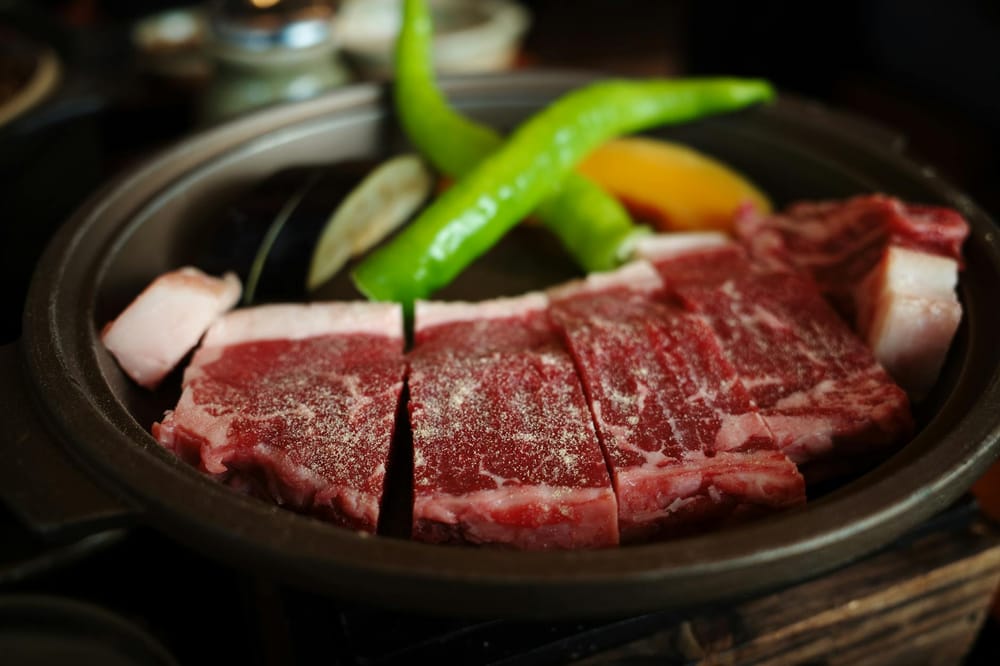
If you enjoy it, graduate to a yakiniku set. A yakiniku Wagyu set at a JAKIM-certified venue lets you compare cuts, typically including ribeye, sirloin, and shoulder loin, grilled at your table. This is where the experience is most memorable.
Reserve A5 for a special occasion. A5 BMS 10-12 is genuinely a once-or-twice-a-year purchase for most Malaysian households. A4 delivers the Wagyu experience at a more sustainable price point and is easier to find on halal menus.
Always confirm halal status the day of your visit. Restaurant ownership and certification can change. A venue that was JAKIM-certified two years ago may not be today, and vice versa. A quick check on the JAKIM halal directory before you go is a five-minute safeguard worth taking.
Frequently Asked Questions
Is all Wagyu in Malaysia halal?
No. Wagyu in Malaysia comes from multiple sources, including Japanese Wagyu, Australian Wagyu, and crossbred Wagyu from other countries. Only Wagyu sourced from slaughterhouses certified by a JAKIM-recognised halal body is halal under Malaysian standards. Always ask the restaurant which certifying body issued the halal certificate for the Wagyu being served.
What is the difference between Japanese Wagyu and Australian Wagyu?
Japanese Wagyu is from cattle raised and slaughtered in Japan, typically of four traditional Japanese breeds, and graded under the Japan Meat Grading Association system using letters A to C and numbers 1 to 5. Australian Wagyu is from cattle in Australia crossbred from Japanese Wagyu genetics, and uses a separate marbling scale called MB. Australian Wagyu is generally more affordable and more widely available in halal form in Malaysia. Japanese Wagyu is rarer, more expensive, and typically more heavily marbled.
How can I check if a Japanese halal certifier is recognised by JAKIM?
JAKIM publishes a list of recognised foreign halal certification bodies on its official portal at halal.gov.my. The list is updated periodically. Look for the country (Japan) and the specific body name on the certificate the restaurant shows you, then cross-check against the published list. If the body is not on the list, the halal claim is not recognised under Malaysian standards.
Can I trust a "Muslim-friendly" Wagyu restaurant that is not JAKIM-certified?
It depends on what assurances the restaurant can provide. A "Muslim-friendly" venue is making a self-declaration, not a certified claim. Ask which Japanese halal body certified the Wagyu, whether the kitchen is segregated, and whether alcohol is served on the premises. Some Muslim diners are comfortable with well-documented "Muslim-friendly" venues, others prefer to dine only at JAKIM-certified restaurants. Both positions are religiously defensible.
What does "A5 Wagyu" really mean?
A5 is the top combined grade under the Japan Meat Grading Association system. The "A" is the yield grade (top of three tiers) and the "5" is the quality grade (top of five tiers). The quality grade combines marbling, meat colour, firmness, and fat colour. A5 Wagyu has the heaviest intramuscular fat marbling, typically BMS 8 to 12, which gives it the buttery melt-in-mouth texture Japanese Wagyu is famous for.
Is halal Wagyu available outside Kuala Lumpur and Selangor?
Halal Japanese Wagyu is most concentrated in Kuala Lumpur and Selangor because the importer ecosystem and the customer base are largest there. Penang, Johor Bahru, and selected resort areas also have venues serving halal Wagyu, but the choice is narrower. Outside the Klang Valley we recommend confirming availability and certification by phone before travelling for a meal.
Does halal Wagyu taste different from non-halal Wagyu?
The taste is determined by the breed, the feeding regime, the marbling grade, and the cut, not by the halal slaughter method. A JAKIM-recognised halal Wagyu A5 sirloin should be indistinguishable in taste from a non-halal Wagyu A5 sirloin of the same grade and origin. What you are paying for with halal certification is the documentation and assurance chain, not a different sensory experience.
Verdict
Halal Japanese Wagyu in Kuala Lumpur and Selangor is real, available, and worth experiencing at least once, but it sits at the premium end of Malaysian halal dining and rewards careful verification. The honest framework is straightforward: confirm the restaurant's JAKIM status, confirm the Japanese certifying body, understand the grade you are paying for, and treat it as an occasion meal rather than a default choice. If you do those four things, your first plate of halal A5 will be the memorable experience it is meant to be.
For day-to-day halal Japanese dining, ramen, sushi, and curry rice at JAKIM-certified venues remain excellent everyday options, and Australian halal Wagyu offers an accessible entry point to marbled beef without the Japanese premium.
For a current, community-reviewed list of halal-certified Japanese restaurants in Malaysia, search the Halal Navi restaurant database.
Sources & references
- Department of Islamic Development Malaysia (JAKIM), Recognised Foreign Halal Certification Bodies list — halal.gov.my, accessed May 13, 2026. (URL no longer accessible — verified 2026-05-16.)
- JAKIM Malaysia Halal Directory (MyeHalal) — myehalal.halal.gov.my, accessed May 13, 2026. (URL no longer accessible — verified 2026-05-16.)
- Japan External Trade Organization (JETRO), Halal Business Handbook for Japanese Exporters — jetro.go.jp, accessed May 13, 2026. (URL no longer accessible — verified 2026-05-16.)
- Japan Meat Grading Association (JMGA), Beef Carcass Grading Standards — jmga.or.jp, accessed May 13, 2026. Accessed 2026-05-16.
- Ministry of Agriculture, Forestry and Fisheries of Japan (MAFF), Wagyu export guidelines — maff.go.jp, accessed May 13, 2026. Accessed 2026-05-16.
About this article
Author: Aisha Rahman writes on Halal Navi's editorial team and covers halal dining infrastructure across East Asia and Southeast Asia.
Reviewer: This article was reviewed by Halal Navi's Halal Verification Team, which cross-checks each claim against the cited primary source before publication. See our editorial standards for the full review process.
Why this article was rebuilt rather than updated: The 2020-era version of this article listed individual restaurants by name with specific prices and certification claims. In rebuilding for 2026, we could not independently re-verify the operating status, ownership changes, and current JAKIM certification status of those specific venues. Rather than republish unverifiable claims, we rebuilt the article as an evergreen verification framework. For current restaurant-level recommendations, please use the Halal Navi restaurant database where listings are reviewed by our Muslim community.
Update policy: We re-verify the regulatory information in this article every six months and the broader framework annually. If you spot outdated information, we will review and correct it within 7 days.
Disclosure: Halal Navi receives no compensation from any restaurant, importer, or certification body mentioned or implied in this article. Editorial judgment is independent.
Last verified: 2026-05-13