Best Halal Ramen in Osaka 2026: 22 Shops and What Backs Each Bowl
Quick Answer: Osaka has 22 halal and Muslim-friendly ramen shops open right now, most of them clustered around Namba and Dotonbori. The busiest and best-reviewed is Halal Ramen Naniwaya in Nishi-Shinsaibashi. If you want a bowl backed by a named certifying body, there are two: Gyukotsu-no-Oh inside Shin-Osaka station, certified by the Japan Halal Foundation, and Halal Ramen Honolu Osaka Namba, certified by the Japan Islamic Culture Center. Beyond those, shops fall into two useful groups — kitchens that are entirely pork-free and alcohol-free, and kitchens that serve halal dishes alongside others. This guide tells you which is which so you can pick the level you are comfortable with.
In August 2026 we went through every ramen shop in Osaka on Halal Navi, confirmed each one was still trading, and grouped them by how their kitchen is set up. The point is not to rank them — it is so you can tell at a glance which shops match how strictly you eat. For the full and current set, including everything that opened after we published, see halal restaurants in Osaka on Halal Navi.
How to read this list
In Japan, "halal" on a shopfront can mean several different things, and the difference is worth knowing before you sit down.
Halal certification means a specific organisation inspected the kitchen and issued a document. It is not common here — certification costs money and takes time, and many careful kitchens have never applied. So certification tells you a third party checked; the absence of it tells you nothing about how good the food or the kitchen is.
That gives three groups, and this guide is organised around them:
| Group | What it means | On this page |
|---|---|---|
| Certified | A named body has certified the kitchen | 2 |
| Whole kitchen halal | No pork or alcohol anywhere, on the operator's own statement | 8 |
| Halal dishes, shared kitchen | Halal options cooked alongside other food | 8 |
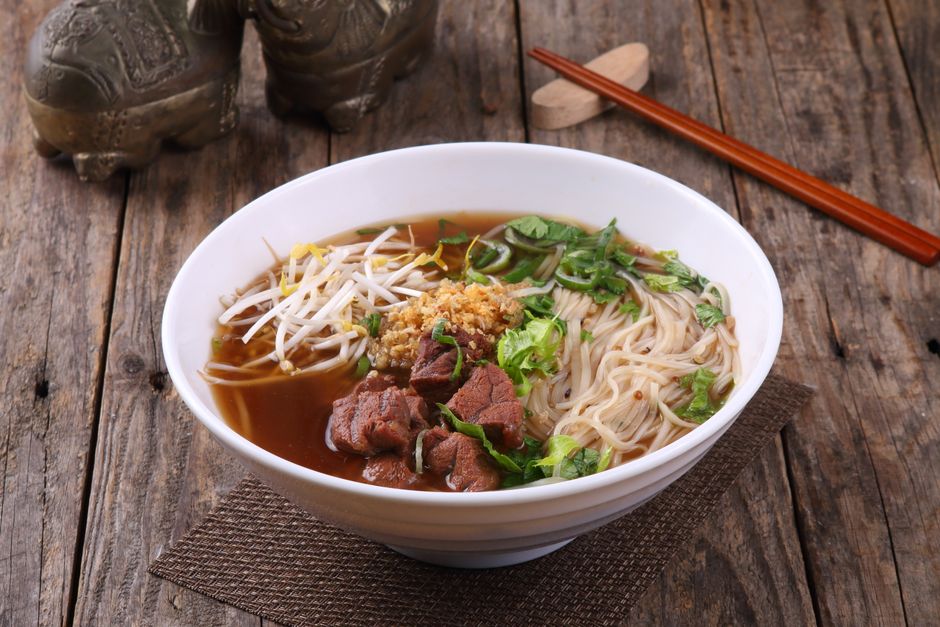
A bowl of beef-broth noodles. Illustrative — not photographed at Gyukotsu-no-Oh. Photo by UNDO KIM on Pexels (https://www.pexels.com/photo/delicious-asian-pho-with-beef-and-vegetables-34834550/)
Certified by a named body
Gyukotsu-no-Oh — beef bone instead of pork bone, at Shin-Osaka
Ramen Gyukotsu-no-Oh (牛骨の王) opened in September 2024 inside Alde Shin-Osaka, in JR Shin-Osaka station.
- Certified by: Japan Halal Foundation (JHF). We did not take the shop's word for this — we found the restaurant on JHF's own public list of certified businesses and matched it by phone number. Checked 21 August 2026
- What the certificate covers: the whole kitchen
- The idea: most halal ramen in Japan works by leaving pork out — chicken broth, or vegetables. This one goes at tonkotsu directly, building the broth from beef bone (additive-free Miyazaki herb beef bones) with Kansai dashi. It is aimed at the richness people actually want from tonkotsu, without the pork
- The menu: BLACK KING, WHITE KING, OSAKA CLEAR, RICH KING and RED KING, with different noodles matched to different bowls
- Why the location is the point: it is inside Shin-Osaka station. If you are changing to the shinkansen, this is a full bowl of ramen without leaving the building
If you only have time for one on this page, and you are passing through Shin-Osaka, this is it.
Halal Ramen Honolu Osaka Namba — certified, but check which branch
Halal Ramen Honolu Osaka Namba is at Motomachi 2-5-27, Naniwa Ward, a short walk from Namba station.
- Certified by: the Japan Islamic Culture Center, which the operator names in Japanese as 日本イスラーム文化センター(大塚モスク) — the Otsuka Mosque
- What the certificate covers: the whole kitchen. No pork, no alcohol, and separate utensils
- Checked: 23 August 2026, against the operator's own online shop, where it names the certifier and lists the certified branches
Now the part that catches people out. Honolu is a chain, and the certification is not chain-wide. The operator names six certified branches: Ebisu, Asakusa, Shinjuku-Gyoen, Nagoya, Kyoto and Namba. Namba is on that list — but if you walk into a different Honolu somewhere else in Japan, you are not automatically in a certified branch.
This is the single most useful habit for eating halal in Japan: a brand is not a branch. Certification is issued to a kitchen, not to a logo.

Inside a ramen shop in Japan. Illustrative — not one of the shops on this page. Photo by Saúl Sigüenza on Pexels (https://www.pexels.com/photo/elderly-man-enjoying-meal-in-tokyo-ramen-shop-37868030/)
Shops that keep the whole kitchen halal
These shops run pork-free and alcohol-free kitchens across the whole operation, not just for a few dishes. Several have been feeding Muslim travellers in Osaka for years and are among the best-reviewed halal restaurants in the city.
Their basis is the operator's own statement rather than a third-party certificate. That is the normal situation in Japan: certification costs money and takes time, and the Japan Halal Foundation's public register lists only four certified businesses in the whole of Osaka Prefecture. Plenty of careful kitchens have simply never applied. If a certificate matters to you, ask at the counter which body issued it — the shops here are used to the question.
Halal Ramen Naniwaya (浪速屋) at Nishi-Shinsaibashi 2-7-22, Chuo Ward, is the most reviewed halal restaurant in this guide by a wide margin — 4.7 across more than 6,000 Google reviews. Halal wagyu alongside the ramen, no pork and no alcohol on the premises. If you want the busiest, most established halal ramen counter in Osaka, this is it. Its listing does not name a certifying body.
One practical note before you go: the name. Naniwaya has had more than one Osaka location and the others have closed, so search for the Nishi-Shinsaibashi address rather than the name alone — older listings still point at branches that are no longer trading.
Halal Ramen Ayam-Ya Dotonbori serves torisoba — chicken-broth noodles, where "ayam" is Malay and Indonesian for chicken. Alcohol-free, and the operator states the whole kitchen is halal. Chicken broth sidesteps the tonkotsu question by design, which is why this style travels so well.
Worth knowing if you are also visiting Kyoto: the Ayam-Ya at Karasuma holds Japan Halal Foundation certification (FPS-108). The Dotonbori branch is not on that register — same name and same broth, a different paper trail. Certification is issued branch by branch in Japan, so it is worth checking per shop rather than per brand.
Halal Wagyu Ramen, Burger, Gyukatsu & Vegan – GYUMON Tsutenkaku (Ebisuhigashi, Naniwa Ward) runs a whole-kitchen halal operation on the operator's statement, and covers wagyu ramen, burgers, gyukatsu and vegan in one place — useful for a mixed group. Note that the group's Dotonbori shop is set up differently and appears further down.
Best Halal Ramen Marhaba! (マルハバ!) at Sennichimae, Chuo Ward, opened in September 2025 and has quickly become one of the names Muslim travellers mention most often in Osaka — "marhaba" is Arabic for welcome. The bowls are built on A5 halal beef and aged halal chicken, made by a Japanese ramen chef without chemical seasonings.
The shop exists because of a specific realisation. While the owner was staying in the United States, he learned that most Muslims simply could not eat ramen, because ramen in Japan is built on pork. Marhaba was the answer to that.
Visitors report halal meat certificates and a halal manager qualification displayed at the counter. Those cover the meat and the person handling it rather than the restaurant as a premises — a common arrangement in Japan, and a reasonable thing to look at while you wait.
Lanzhou Halal Beef Lamian Noodle at Nanbanaka, Naniwa Ward, brings hand-pulled Lanzhou beef noodles to Osaka — a dish from a predominantly Muslim region of China, so the halal tradition is built into the cuisine rather than adapted for it. Ask whether the whole kitchen is halal when you order.
Osaka Buyu-Den (Higashi-Umeda) describes itself on its own site as "100% Halal", controlling compliance "from ingredient sourcing through cooking, kitchen standards and equipment". The reason to put it on your list, though, is that it has a prayer room on the premises. A halal bowl and a place to pray in Umeda, in the same building, is a rare combination.
Halal Namba Ramen (Nishinari Ward) comes to us through visitor reports, and we have not been to it ourselves — so treat it as a lead rather than a recommendation, and confirm when you arrive.

Neon signs at Dotonbori, Osaka. Most of the shops on this page are within walking distance of here. Photo by Royce Ho on Pexels (https://www.pexels.com/photo/vibrant-neon-signs-at-dotonbori-osaka-japan-28608380/)
Shops with a halal menu in a shared kitchen
Eight more Osaka ramen shops offer halal dishes from a kitchen that also cooks other things. For a lot of travellers that is perfectly workable, and it widens where you can eat considerably — especially if you are with non-Muslim friends who want the pork bowl.
The one thing to establish at the counter is how far the separation goes: which dishes are the halal ones, and whether the pots and the fryer are shared. Staff at these shops answer that question all the time.
In this group: RAMEN KASSAI (Nipponbashi), Halal Beef Bone Ramen Ushibon (Namba, in the same building as Honolu), Osaka Halal Ramen Wagyutei (Higashi-Shinsaibashi), Yakiniku Yodoya Osaka (Dojima), and GYUMON Osaka Dotonbori.
One group states its position unusually clearly, and it is worth reading before you decide. The wagyu ramen shops at Dotonbori (Namba-Tei), Shinsaibashi, and Shinsaibashi Wagyu Halal Ramen Noodle say on their own site that they are pork-free and alcohol-free, and that they are not officially halal certified. Being told exactly where a kitchen stands, without having to ask, is genuinely useful — you can make the call with the facts in front of you.
What changed since our last update
Alohana Vegan Ramen in Chuo Ward was recommended in the previous version of this guide. It has been temporarily closed since 12 August 2026 — temporarily, not permanently, so it may return. Do not plan around it for now.
While we are here: vegan is not halal. A plant-based bowl removes the pork question, but it does not answer the alcohol question — mirin and cooking sake turn up in seasonings that contain no meat at all. Veggie Ramen Yuniwa in Hirakata is a vegan shop with no halal information recorded; if you go, ask specifically about mirin and sake in the tare.
📱 Find halal restaurants, prayer rooms and Muslim-friendly places across Japan with the free Halal Navi app.
Download on the App Store · Get it on Google Play
Praying around a bowl of ramen in Osaka
Osaka Prefecture has two mosques holding Friday prayer — one in Nishiyodogawa Ward and one in Ibaraki city. Neither is in the Namba core, so plan the journey if you need jumu'ah.
For daily prayers in Namba itself you are better served by the prayer rooms at Namba City (connected to Namba station) and Daimaru Shinsaibashi. Several halal restaurants in the area also keep a musalla for guests, which pairs neatly with a ramen stop — ask when you arrive rather than assuming.
If you are flying through Kansai International Airport, prayer rooms are available in both departure and arrival areas. Confirm exact floor locations on the airport's own website, as room positions move with renovations.
Planning the meal around Dhuhr or Maghrib is easiest in Namba, simply because the halal venues are dense enough there that you are not spending the gap on trains.
Frequently Asked Questions
Is there certified halal ramen in Osaka?
Yes — two shops. Gyukotsu-no-Oh at Shin-Osaka is certified by the Japan Halal Foundation, and Halal Ramen Honolu Osaka Namba by the Japan Islamic Culture Center. Every other halal ramen shop in Osaka is listed on the operator's own statement or on visitor reports, not on a certificate we can trace to a named body.
Why do so many shops say "halal certified" without naming a certifier?
Because in Japan the phrase is not regulated the way the certification itself is. A shop can put up a sign, or a directory can copy a claim from another directory, and nothing checks it. On this page we say certified when the certifying organisation can be named, and describe everything else by how the kitchen is actually run. Both can be a good meal — they are just different kinds of assurance.
Is Ayam-Ya halal?
It depends which branch. The Karasuma branch in Kyoto holds Japan Halal Foundation certification (FPS-108). The Dotonbori branch in Osaka is listed on the operator's statement, not on that register. Certification is issued to a kitchen, not to a brand.
What makes ramen not halal in the first place?
Three things, usually. Tonkotsu broth is pork bone. Mirin and cooking sake in the tare contain alcohol. And chashu is traditionally pork belly. A halal bowl replaces all three — chicken, beef or seafood broth, alcohol-free seasoning, and chicken or beef chashu — and keeps them away from the pork side of the kitchen.
Is vegan ramen halal?
Not automatically. It solves the pork problem and it usually solves the cross-contamination problem, but alcohol-based seasonings are not animal products and can still be in the tare. Ask about mirin and cooking sake specifically.
Verdict
Osaka is one of the easiest cities in Japan to eat halal ramen in, and the choice is wider than most visitors expect — 22 shops, most of them within walking distance of Namba.
If you want the certificate: Gyukotsu-no-Oh inside Shin-Osaka station, or Honolu at Namba.
If you want the bowl everyone talks about: Naniwaya in Nishi-Shinsaibashi, 6,000 reviews and still a queue.
If you need to pray while you are out: Buyu-Den in Higashi-Umeda has a prayer room on site.
And whichever you pick, the counter staff at these shops field halal questions every day — asking which dishes, or which body certified the kitchen, is completely normal here and nobody minds.
🛏 Staying in Osaka? We list 22 places to stay there, and each one shows how many halal restaurants are within walking distance.
See places to stay in Osaka →
Muslim-friendly stays in Osaka
All of these are listed in the Halal Navi database as Muslim-friendly. What each property declares is different, so the note is what the property itself states — confirm anything that matters to you when you book.
- Richmond Hotel Namba Daikokucho — Muslim-friendly facilities declared by the hotel: Hotel serves halal meal. See the halal details Halal food within walking distance: 3 places (1 certified) · nearest 167m. Lanzhou Halal Beef Lamian Noodle 167m · Adlon French Tacos ( HALAL ) 254m · Vitti Halal Cafe & Restaurant Osaka 389m.
- Sheraton Miyako Hotel Osaka — Muslim-friendly facilities declared by the hotel: Hotel serves halal meal. See the halal details Halal food within walking distance: 1 place (1 certified) · nearest 428m. MOMO’s Cafe & Restaurant Osaka Halal Restaurant 428m.
Sources
- Japan Halal Foundation — certified business register — Gyukotsu-no-Oh and Ayam-Ya Karasuma (FPS-108), checked 21 and 19 August 2026. Searched again for Osaka on 25 August 2026: four certified businesses in the prefecture, one of them a ramen shop
- Halal Ramen Honolu — operator's halal shop — the six certified branches, checked 23 August 2026
- Honolu official site and the operator's online shop — the named certifier and the six certified branches
- Osaka Buyu-Den official site — "100% Halal" and the prayer room, no certifier named
- GYUMON group
- Halal Navi venue database — 22 Osaka ramen venues, each checked against its Google listing in August 2026
About this article
Written and fact-checked by the Halal Navi editorial team, August 2026. Halal status changes — certifications lapse, owners change suppliers, and branches open and close. Confirm directly with each venue before you rely on it, and tell us if you find something out of date.